Showing posts with label Scotland. Show all posts

Thursday, July 24, 2014

Visibility

Scotland has moved from industrial to post-industrial state. One can see the evidences and characteristics throughout the place easily. The capability of being readily notice is the definition for visibility. I am interested in seeing the different aspects of development of Scotland especially about how Scotland is putting effort in being environmental friendly. Therefore, I have chose visibility as the theme for my study abroad program.
Post-industrial - taken from http://www.bloglet.com/understanding-the-values-of-a-post-industrial-society/

Since I have decided the topic that I want to focus on, I start to do the research. Then, I have found a surprising fact which is Scotland has been one of the leading roles in sustainable developing in Europe. I have never thought that Scotland would be a candidate for being so environmental friendly and then, I begin to wonder the reasons behind it. After some research, I have found various evidences from small to big or digital to physical objects.
Flag of Scotland - taken from http://www.desktopc.com/2193/scotland-flag-wallpaper.html/scotland-flag-wallpaper-2

From my perspective, I think the tone that the Scottish government uses on its energy website encourages its citizen to participate in a series of activities of install renewable energy equipments. Thus, one can see solar panels install on the roof of the individual household. Another visibility example is the hand dryer in the restroom. In Scotland, most of the restrooms provide only hand dryers instead of paper towel. Replacing paper towel by hand dryer will save water, trees and reduces solid waste and the amount of resources depletion. There are numerous case studies conducted at schools to prove that the use of hand dryer is more environmental friendly than use of paper towel produced from recycled materials. The last example that I want to use to demonstrate visibility of being “Green” is the tram in Edinburgh. Tram only relies on electricity to power, so there is zero emission. It also decreases the usage of cars and transport significant number of people to Edinburgh airport.
GREEN Earth - taken from http://technology-green-energy.blogspot.co.uk/2013/07/green-earth-technologies.html


After being in Scotland for one and half months, I really think other parts of the world should follow it as a paradigm to make Earth a better place to live on. This blue giant, Earth, has once been beautiful and clean. However, human activities have polluted and destroyed it. If we do not start working on restoring or at least improving the environment, human may extinct before we are capable of travelling and residing in another planet. Please cherish mother Earth!

Tuesday, July 22, 2014

Local Stranger

Night view of Dundee - by author
Port of Dundee( Marine Parade) - by author
Penguins in clothes at the side of church - by author
RRS Discovery Ship - by author
University of  Abertay Dundee - by author

Friday, July 18, 2014

Multimedia and Modern Storytelling


A picture of a Neil Gaiman poster and a ticket
Photo credit to the author
This past weekend, I was lucky enough to go see Neil Gaiman present his newest book in what was referred to as a "multimedia presentation". 

You may be asking "A what?"

He teamed up with FourPlay string quartet and the illustrator for his newest book in order to create four shows, the likes of which I've never seen. This could easily be the path that author presentations take in the future.

The quartet knew their audience: they started off with vaguely creepy sounding music and added a base line, and to the entire crowd’s shock, they opened the show with a rendition of the Doctor Who theme song. Neil has written two episodes for the show, so it was a reasonable guess that a number of people there would at least recognize the theme.

Neil came on to finish the first half of the show with a series of short story readings. He’s been involved in a number of innovative projects, such as a social media experiment on twitter where he asked questions, chose an answer, and wrote a short story for each month of the year. I’d highly recommend reading them, they’re available here with his journal explaining the project here. He read the October piece in Edinburgh.

The piece that hit me hardest was The Man who Forgot Ray Bradbury (available to listen to here in his blog). It's about a writer who slowly loses his memories with age. More importantly, to him, is the way he slowly loses stories. As a writer and prolific reader, Alzheimer's and memory loss are terrifying to me, yet I know full well that it runs in the women in my mother's family. My grandmother hasn't recognized me as myself in years, and the early onset form is slowly starting to have other impacts in the family.

To quote my aunt, "You either have to laugh about it or cry about it," and most of the time the family has had enough of tears. Still, the way he verbalized one of my greatest fears, almost cheerfully, never taking on the impossible frustration of losing memories, brought me to tears.

The full novelette of The Truth is a Cave in the Black Mountains, available here is excellent, but if you’re unfamiliar with Neil’s work, there’s one thing you need to keep in mind: he is primarily a storyteller. One of the best things you can do is listen to one of his audiobooks, most of which he has read himself. The Truth is a Cave in the Black Mountains is based on traditional stories told about the Isle of Skye.

One of the most interesting things about the things Mr. Gaiman has produced is the variety of ways in which he has produced it and presented it to the public. He constantly interacts with fans (he has official facebook, a blog, and tumblr, as well as a twitter account he used for the months of the year prompts). The interaction not only gives fans a way to interact with him, but also ways for him to see what they want to know. In recent years, he has published short stories or prologues to pieces finished years ago, such as How the Marquis got His Coat (a companion piece for Neverwhere) and the Overture run (a prologue run for the cult classic Sandman comics). Those pieces have been released in part because his fan base has grown, but also because of the feedback from his readers.

His reader interaction is almost an art form in itself, and collaborative work has been produced from it. The Blackberry project produced a dozen short stories based on prompts from fans, which I provided a link to earlier in this post.

What are the newest ways of publishing, and how can an author grow a fan following that is so loyal, it can beat Harry Potter fans when it comes to the production of London's 51st literary bench? (That happened just recently, by the way. Details can be seen here. Neverwhere beat the Harry Potter series, most likely because of fan persistence during the voting process. It broke my heart in two to vote against Harry Potter, but...ah well.) How do you build a group so loyal, they've already started voicing opinions on the upcoming casting for the TV series of American Gods, which will be produced in the upcoming year? How can a fiction author, one who has been in the business for years, continue to widen their creative endeavors?

Those questions are being answered in different ways, but I believe that Neil Gaiman and his publishing team are certainly on the right track. His fan following has grown in recent years, and even readers that have stuck with him for a considerable time have branched out into his other work (ex: reading the Sandman comics because I enjoyed his novels so much). They turn fiction into art, and a part of how they have done it is by transforming books into stories, told on page and by mouth (Mr. Gaiman reads almost all of his own audiobooks), through radio show (the BBC produced a star-studded serial broadcast version of Neverwhere) and through TV (the upcoming series for American Gods). His stories are finding niches and cracks in almost every genre and every form of media, and the tell-tale signs in his work are like songs that get stuck in your head. You can read his work a number of times, and still take away something new each time. No matter what media source the story comes through, the seed of the story is always given over to the reader to take root and grow.

Personally, I think what they're doing is working.

Tuesday, July 15, 2014

boxes, wheels, and needles

Last week I wrote about the ways places/artifacts/work in progress are hidden and covered and/or announced or displayed, to various degrees. Those ideas and some of the other readings I’ve been doing have led me to a really great and useful-seeming metaphor: the black box. I have classmate Ben (plus the ever-handy Wikipedia) to thank for enlightening me as to the surprisingly simple origins of this term. It comes from electronics, where a black box is literally an opaque box of wires that do magical, unseen (but not un-detectible) things. The general definition gets a bit fancier: “a device, system or object which can be viewed in terms of its input, output and transfer characteristics without any knowledge of its internal workings.”

Black boxes are everywhere. Almost anything can be interpreted in some black-box-ish way for someone. Part of what modern life is all about involves some things being mysterious to some people but not to others; specialization allows us to safely ignore a lot of stuff in favor of becoming an expert in a more manageable amount of stuff. The deceptive simplicity of the black box concept makes it easy to apply and fairly easy to talk about. How useful will it be for me and my as-of-yet wild, untamable research interests? I'm not sure.

A seemingly-tangential thought on black boxes and all the frames in which they show up comes from Andrew Feenberg's collection of essays Between Reason and Experience. He uses the example of steamboat boilers in the early 1800s. At first, there was no regulation, no legally enforceable standards for boilermakers. Society seemed fine with the risks of exploding steamboats for years... until, finally, when laws were eventually passed to enforce safety measures, the standards those laws enforced became part of what made the technology of the steamboat boiler what it from then on was. No other kind of boiler could be considered a "proper boiler" (22). No other way of making this thing was acceptable, so the standard solidified into a default technical code. The code itself was never questioned, rarely examined at all. The process whereby it was decided upon faded away and allowed the code to function as a closed book, efficient and nigh-invisible. According to Feenberg, standardization is a black-boxing process. Once a standard forms, it tends to become an unquestioned, unexamined packet of the Way Things Are.

From here, it gets a little bit easier to see whole networks of infrastructure, whole paradigms and vast ideologies as black boxes. They are at work in the way things happen in our lives, but we don't often notice them, much less look inside them. Almost nobody questions whatever gets put in the boxes, especially if some official, complicated, voted-on ruling put it there. it’s settled. That system becomes dominant and invisible.

That doesn't mean we absolutely can't see them though. Electricians un-black-box light switch wiring and fuses all the time. That's their job. Academics un-black-box (or attempt to) ideologies all the time, too. That's their job.

Interestingly, the black box has an opposite: the clear or glass or white box. These are systems or objects that open themselves up to every scrutiny, eager to show off their inner workings. The clamor for transparency is a hunger for more (and hopefully friendly) white boxes and fewer (monolithic and scary?) black boxes.

But I wonder if no matter how transparent or open we try to make the boxes we work with (and/or within), maybe we’ll always find more black boxes inside. I'm indebted to classmate John for the wonderfully allusive phrase "Black boxes all the way down" to describe this. He responded (via good old facebook) to my post over here with the thought that "transparency largely depends on perspective. For example, opening the (sometimes literal) black box of a printer, with the goal/perspective of fixing a paper jam, repairing a component, salvaging electronics, getting at scrap metal, etc., means different versions of transparency." I love the word matryoshka for describing these arrangements, even if I do occasionally misspell it. The matryoshka-ness of black boxes specifically is very possibly one of the most mind-bendingly fascinating things I've thought about for a long time.

Now I want to ask questions about when and why certain ideas or technologies get black-boxed and when they get un-black-boxed. What kinds of influences make us stop at which black box (or painted doll)? As John mentioned, there are varying layers and motives for cracking open a black box. Maybe it's your job, maybe its a toy, or maybe both. Everyone has a different level at which they might need or want to understand or be proficient with any given technology. But on a general paradigm-sized scale--say on the scale of general knowledge and expectations about the world--what should we consider black-boxed and when?
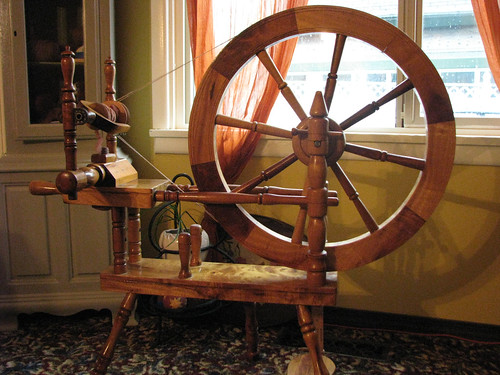
Myrtlewood Spinning Wheel c.1970s
{ photo by this kind soul on Flickr. }

Does this spinning wheel count as a black box? Do you know how to use the thing? You see them in movies and maybe at a historical re-enactment or two. Does that mean the technology is accessible?

I'm not sure. I don't know if I could use a spinning wheel, though I've seen it done. How much do I need to know to be inside the black box? Even if you spend hours watching somebody sitting at this wheel with a basket of flax or wool, feeding fibers through and around and into the machine, does that mean you really get it? This is where the levels come in, I guess. You might sort of get it--at least moreso than anyone who had only ever seen flax and thread (or fabric--but that's another machine/box altogether) on totally separate sides of the process.

Last week on Wednesday I visited Dundee Contemporary Arts for their weekly knitting workshop. Two others were there and we sat for an hour and a bit chatting about Scotland, the referendum, the world cup (are you supposed to capitalize the world cup? are there rules about that?), cars, and housing developments. I don't knit, really. But I have learned (and forgotten) how to do it more than once. I wouldn't call knitting expertise a total black box for me. Even though crochet is more my thing, crafts of this kind are part of the world I regularly inhabit and interact in. I can see and recognize how knitting happens--not just that a ball of yarn can become, somehow, a sweater, but that needles of a certain size, the number and position of those needles, plus a very particular pattern of stitches all matter in that process. This knowledge goes some way to un-black-boxing all kinds of knitwear and other knitted/crafted material for me. I can read those parts of the manufactured world at a basic level.

Out of curiosity, I did some research on knitting, past, present, and future. In the beginning, we humans wanted to keep our feet warm, so we invented an intricate way of looping and knotting string into fabric shapes. But sock-making is not why I keep yarn and a crochet hook around today. Like hand-spun thread, hand-made socks are a rarity. You probably don't have a spinning wheel sitting in your living room and you probably buy your socks from a store. We don't need to make our own socks or anyone else's. We have giant industrial knitting machines for that.
Even after watching a very cheesy video about how this process works, computerized knitting seems much more of a black-box than hand-knitting does to me. All those machines probably contain their very own individual galaxy of black boxes, too, not to mention the protocols and standards set up for spool widths and sock sizes and all the electricity it takes to run such a factory.

Is this what industrialization means? An exponential increase in the black-boxiness of even the making of a sock? Assigning most of the work to machines and divvying up the rest among specialists and technicians?

If so, perhaps post-industrialization means unearthing the black boxes of the past and returning to pre-industrial methods out of non-industrial, non-commercial, non-essential motives. Today, in this arguably post-industrial century, most people don't knit because they need to. Knitting is a lovely, relaxing hobby. If you get a pair of socks out of it, cool. But that isn't the primary end. The end and the means overlap here: you enjoy knitting for its own retro/crafty/creative sake.

The morning after my visit to Dundee's knitting circle, we went to see the Falkirk wheel. This is a peculiar project, one of many funded by the Millennium commission over the past dozen or two years. There is a lot to be learned at the site. Seeing the wheel itself and getting a sense of its place between the Forth and Clyde and Union canals is much cooler than reading about these things on the Scottish Canals website, though there is plenty to be learned there, too. The connection between these canals and knitting came to me over the course of our long Thursday excursion up and back down the wheel and then along the canal itself.

The Falkirk wheel exists to be looked at, not really to accomplish anything. Much like the warmth of my feet does not depend directly on my crochet projects, the economy of Scotland doesn't directly depend on this magnificently engineered section of a long series of canals. There are industries and markets surrounding these two technologies, sure: tourism, novelties; Etsy and craft supply stores. These are markers of post-industrial society as well, perhaps. More and more specialization, more and more extended niches where money can be made and life can be spent.

Both the Falkirk wheel and the DCA knitting group have their deepest roots in the technologies and crafts of pre-industrial life. Canalboats and hand-knitting aren't technically extinct technologies (yet); so far their boxes can be easily unearthed, un-blacked, and we can access/support these avenues, processes, and skills if we want. But we'll probably do so for the sake of the things themselves. For leisure and not as a means to some other, more essential end.

Sunday, July 13, 2014

T in the Park


T in the Park is a weekend-long music festival that has been held in Scotland each summer since 1994. Approximately 100 bands and artists perform throughout the weekend each year, with widely known artists like Coldplay, Beyoncé, Eminem, Mumford & Sons, The Killers, Rihanna, Florence + The Machine, and Foo Fighters having graced its stages in the last decade. Many other popular artists perform here, as well as up-and-coming unsigned artists, with music genres ranging from indie rock, techno rock, pop, hip hop, and more. The event brings in well over 100,000 people throughout the weekend, making it the one of the largest music festivals in the world.

As a musician and music lover, I felt drawn to T in the Park the moment I learned of it. What makes it even better is that it only took place 45 minutes from my temporary home in Dundee! In the video above, you'll get just a taste of what makes T in the Park such a special event here in Scotland, and perhaps you'll want to attend next summer too.

Sunday, July 6, 2014

Trains of Thought

In the States, train travel is sometimes disregarded as the slowest and most boring way of getting from one place to another. A traveler might, for example, board Amtrak's Empire Builder in Chicago with nothing to look forward to for the next thirty two hours but the prospect of staring out the window at the cold and frozen expanse that is North Dakota and Eastern Montana until they finally pull into Whitefish, Montana bleary-eyed and half mad from the whole mind-numbing experience. The urge to go to sleep and lie comatose for the duration of the ride outweighs the novelty of the situation by an order of magnitude. This was my opinion of train travel for years, and as such was not looking forward to the plethora of train trips, both long and short, that this adventure would entail.

Now at the halfway point in this journey, I realize my opinion of train travel had been tainted by my one experience on American trains (the terminally dull trek described above) and I must revise my opinions on the subject. Last weekend I had the opportunity to make my way down to Nottingham, England. While this trip could have been made in a fraction of the time had I chosen to travel by air, the cost would have been far outside my travel budget, and I had yet to use any of my fifteen travel days on my Britrail train pass for a recreational excursion, so I sat down and planned out the route I would need to take to get to Nottingham at a reasonable hour. It would be a six hour trip, and if I caught the 6:32 AM train from Dundee I could get there with only one transfer. The early morning departure and lengthy transit time were unexpected, but I reminded myself that this was really the only way I would be able to go anywhere outside Dundee, and so gritted my teeth and committed to the early morning call at Dundee station.

The morning of my departure, I was struck with all manner of concerns: What if I miss the train? What if my pass doesn't work? How can I sit still for six hours? Fortunately, these worries evaporated as soon as I boarded the train and staked a claim on a window seat. As the train pulled away from the platform, I was suddenly struck by how ordinary this all seemed to the other passengers. Trains are not a novelty here; they are a way of life. To everyone else, this was ordinary. I calmed then, suddenly confident in their trust of this mode of travel, and settled in for the six hour ride. There were no snags, no confusing moments, and no delays. I arrived in Nottingham within a minute of the predicted time thinking how much more pleasant and relaxed the whole experience was compared to flying, or even driving my own car.

Why is train travel so commonplace here, while in the US it is often only a last resort? A large part of that, I think, is the distances involved. even the longest train route in the UK travels less than seven hundred miles- a long trip to be sure, but nowhere near the distances spanned by American railways. Air travel is so much more convenient over those distances that trains seem irrelevant by comparison. In addition, US railways have a poor reputation for reliability, which further lowers the opinions of many travelers. Trains were an important part of American culture, but as soon as something better came along, they were abandoned. However in the UK, and Scotland in particular, the railways are still embedded in the minds of the people as part of a national identity. Consider, for example, the city of Edinburgh's efforts to bridge the Firth of Forth. What started as a simple ferry system 900 years ago has become two (soon to be three) bridges that stand as a reminder of the times in which they were built, and the oldest of these is the Forth Bridge, an enormous cantilever rail bridge straight out of the height of the industrial revolution. This bridge has stood as a gateway to the north for nearly 125 years, and will continue to stand for the foreseeable future. It is a testament to both Scottish engineering and the importance of the railways that the first steel bridge in the world was constructed here so as to allow trains better access to the northern parts of the country, and that it still stands strong today. 

Friday, July 4, 2014

wet paint and the visibility of process

I've been seeing "wet paint" signs all over the place lately. Just this morning on our way to class we passed a few men with rollers and brushes re-painting the fence around the high school. Chalked warnings all along that side of the walkway warned pedestrians about the paint, marking a distance between foot traffic and the work-in-progress. In Edinburgh, too, there were placards placed outside several storefronts. I failed to take any photographs of them, so all I can give you are brief descriptive sketches of plain sandwich boards propped up under glossy window grates or simple laminated sheets of paper zip-tied onto open window shutters, all declaring "wet paint" and implying "please don't touch or smudge or disturb this area."

In Cockburn Street there was a man on a ladder, with bucket and brush, putting in a few lines of bright pink detailing behind the words "Pie"and "Sky" above a shop door. He was not accompanied (when I saw him at least) by any printed "wet paint" notice. His presence (and the ladder's) was enough of a warning, and perhaps the height of his hand-painted sign would exempt it from the need of any other.

Perhaps it is the few days of sun we had that's prompted so much repainting? Or maybe this kind of small-scale maintenance goes on constantly, and it's anyone's guess what's prompted me to notice it. The wet paint signs are a subtle and temporary form of redirection/crowd control. I am noticing plenty of other methods, less subtle, but presumably almost as temporary, for reasons beyond paint--airport hallways halved by plywood enclosures, whole streets closed off and walkways blocked by aluminum fences or orange cones. During my time in Manchester, a sidewalk diversion over/around a new tramway construction site seemed to shift several feet every time we walked back that way. There were men in orange vests and hard hats milling about, posted signs instructing cyclists to dismount and take care, and make-shift ramps from the existing pavement to the level where all this work was being done. Having recently read and written about Shapin and Schaffer's Leviathan and the Air-pump: Hobbes, Boyle, and the Experimental Life, I started breaking all of these situations down using three technological categories: material (the fences, the ramps, ladder, paintbrush, the strewn-about tools), social (our training in walkways, the significance of orange vests and brawny workmen, our polite obedience to posted notices), and literary (the language and color of the posted signs themselves) tech.

Along with this, I thought about processes, and our tendencies to overlook them in favor of finishedness. We are often asked to overlook works in progress. Don't stop here--you might get paint on your sleeves. A tourist is not supposed to notice the unbuilt, unfinished sections of a city.

Well okay, a man on a ladder hand-painting a quaint pie-shop sign might add to the quaint ambiance of a place like old-town Edinburgh, but scaffolding around the grand, crumbly old castle will always be unsightly and unfortunate, right? We of course accept it as a necessary side-effect of preservation efforts and hope it'll all be finished and out of the way when we visit next time. It's a sort of trade-off.

If we are lucky, the construction scaffolding will be decorated with a pretty skin. This one (pictured above and below) around the National Library of Scotland caught my eye while we were in Edinburgh this week. Mixed in with the apologetic explanations for the building's state are little visual vignettes about the library's contents. It's a little bit advertising, a little bit educational, a little bit quirky entertainment, all sharing one lovely blue background.
The workmen probably didn't expect this tourist to be taking such intrusive photos of their worksite and its shell. This is not the main attraction; it's an underbelly, meant to stay as much behind the curtain as possible.

Are there material, social, and literary technologies mixed in here, as well? Sure. They are everywhere. Technical and professional writing (and yes, I count the doodles on this scaffold-cover as technical writing--don't you?) seem to combine them all in the most diverse ways whenever machines/tools/material tech + groups of audiences all need to work together using language and rhetoric.

Our class had the privilege of learning about and observing the work-in-progress of a new Forth road bridge, plus the interesting historical and technical details of the trio it will complete when it is finished. I was struck by both the grand, plodding pace of it all and by the deep, unpredictable necessity of engineering adaptations that have had to happen as part of the bridge-building process.

We didn't see any "wet paint" signs or their equivalent surrounding the new bridge site. We were specially invited into the education center to notice and bear witness to this set of spaces, despite their unfinishedness. There weren't any apologies for the state of things; rather, there was pride and confidence surrounding the project's huge arms and legs and lifespan. The histories and futures of the bridges were presented beautifully. 
Our role in such a space isn't like the role of the tourist confronted with a scaffold-wrapped monument. Our job is not to spend money and send postcards home anymore. I'm not sure what it is exactly. Not quite tourism, not quite school field trip, or something. Our invitation to the Firth of Forth this week did not come without conditions. We were invited so far, and no further. We were only allowed so much. In some ways the educational center and its staff managed our movements just like wet paint signs, aluminum fencing, and orange cones do with touristy foot traffic.

Who knows if this will become a theme for me or not, but I am very interested in where all these boundaries tend to fall and why. The lines (or do I want to call them grades or levels or spectrums instead?) between allowed and not-allowed, between unfinished and finished, between open-access and top-secret... how do they compare to the line between wet paint and dry paint?

(unknown)

While the plan of not planning can take you to the more unexpected corners of a country, it can teach you a lesson in just how much to plan further on in the future with, say, other trips. Studying abroad in the UK has yet been my biggest adventure and I have yet to regret the decision of leaving a comfortable life behind to settle for a month in an unfamiliar place with so many unfamiliar faces. The residents of Dundee and all cities surrounding have been welcoming and comforting to myself and the Purdue Study Abroad group attending. Some more welcoming and excited than others, such as Ronnie at the Ninewells Hospital.

After about a long roaming tour of the Ninewells Hospital here in Dundee, I trust that I know the ins and outs of the hospital. From Frank Gehry’s “Maggie’s Centre” out back above the landscape to the hospitalization learning center for students underground, the Ninewells hospital is equipped with many features I was seeing for the first time. The atmosphere gathered an entirely new focus and theme regarding the student’s performance skills. Hands on activity is emphasized in an entirely different fashion with microphones about the ceiling and mirrored windows for supervision purposes.

Aside from the post-industrial aspects of Dundee’s newer technologies, we went back a few years or so to the Dunnottar Castle dating back to the late 16th early 17th century in Stonehaven, Scotland. Cliffs as high as 5 story buildings held the ruins of a castle so old, only sea gulls and pigeons dared to live in the dark fireplaces and cracks of its remains. Dunnottar Castle inhabited some of the most beautiful sights I had ever witnessed in life with shores similar to that of what you would find in a Pirate of the Caribbean film, large rocks where the sea meets to the shore for daring adults like ourselves to hop across for a simple look into the life under its waters. And the waters of Scotland, let me tell you about the waters of Scotland.

Our next big adventure as a group consisted of fish, bridges, and airplanes just meters overhead. On our trip to the Pitlochry Dam, streams lined the streets and cottage houses along the way. The dam was quiet and content on one side while it’s process created stirring and blundering water over the rocks on the other side. Myself and two other group members walked into town after learning about the dam, discovering a bridge not so still with pedestrians walking across, and not to mention my first fish and chips since arriving in Scotland.

 Next up was the Edradour Distillery in Pitlochry which was my first experience at a distillery. This trip gathered a many first for me as it was my first hiking experience, my first tall waterfall (which was not man-made as I was expecting the entire time), and my first beverage tasting experience.  Above the treelines we stood on our hike to to the distillery taking in the range of green fields like nothing I had ever experienced. At 800 feet we continued to the distillery where we learned of casks worth a quarter of a million pounds alongside 3,000 other casks all stacked in one warehouse for the next several years.

Having not planned any of the trips thus far, Scotland has been an incredible exploitation of many firsts for me. There is much more to look forward to being only two weeks, or a third of the way into the study abroad trip here in Scotland.

Tuesday, July 1, 2014

Living Beyond the Living Room

The living accommodations with which we have been provided by the University of Abertay are far better than I expected. We have two toilets, three shower stalls, four bathroom sinks, a large kitchen equipped with two refrigerators, one dishwasher, one fully functioning oven, one large kitchen sink, and a microwave. Furthermore, each of us is also fortunate to have our own bedrooms (which is great not only for privacy, but to avoid being kept awake with one another’s snores) equipped with a twin size bed, desk, wardrobe, overhead shelf, and a small dresser. 

University of Abertay's flat accommodations at Alloway Halls in Dundee. (Photo by author)
Needless to say, our housing situation came as a pleasant surprise for all of us, however, I couldn’t help but notice our lack of what is perhaps one of the most utilized rooms in anyone’s home - a living room. There were no couches gathered around a television, with a coffee table in the center for us to prop our feet upon after long days of studying, researching, and exploring Dundee. Though I imagine each of us could access our beloved Netflix from our personal laptops during our downtime, I found myself somewhat longing for the idea of Disney movie nights with my flatmates, curled up on couches with blankets and freshly baked pastries.

Now, don’t get me wrong. I’m not complaining, and nor did I ever resent our lack of living room. It’s just that I am most familiar with bonding with friends and family in the comfort of a living room, convinced that I was in fact living. After accepting our accommodations as they are, I became somewhat thrilled at the challenge of pursuing life outside of the living room. Our community entertainment will not come from a screen during our six weeks in Scotland, and we must learn to live beyond the living room.

Since our arrival, I have seen and done things that could never be accomplished without a break from my comfort zone. I broke away from my introverted tendencies and made friends with complete strangers. I chatted with them in pubs, live music venues, bus stops, trains, and even standing in line at the grocery store (side note: lines are referred to as 'queues' here). I've distanced myself from my somewhat lazy habits and hiked through rolling hills, skipped the bus to walk through town, and climbed numerous steep inclines and seemingly endless steps (particularly in Edinburgh!). Instead of turning to a television or computer screen for excitement, I've visited the ruins of a 16th century castle, attended a live music festival in the city, and played lots of euchre (pronounced YOU-ker... it's a 4-person card game that is very popular in Indiana) with my flatmates at the kitchen table.

The beautiful countryside of Pitlochry... My group got somewhat lost on the way to Edradour, which is Scotland's smallest distillery, located in Pitlochry. (Photo by author) 

Live music being performed at Buskers, which a church-turned-pub in Dundee. Bands played at pubs all throughout the city for the entire weekend for what was called the Almost Blue Festival. (Photo by author)

Though a living room is certainly a friendly, comfortable place to settle down at the end of a long day, there is nothing that a living room can offer that would even come close to the vitality and exuberance I have experienced since I was forced to live beyond the living room.


Friday, June 27, 2014

Paris Maker Faire 2014: A Post-Industrial Journey

Update: For more pictures from the Paris Maker Faire, see my Flickr album
For videos, check out my YouTube playlist

Last weekend (June 21 and 22), I attended a Maker Faire in Paris as part of my thesis research on maker communities. Maker Faires are physical sites where makers--anyone who creates physical things--of all types come together to showcase what they have made, and to share technical knowledge with other makers and broader publics. These events emphasize learning how to make through play and other tangible interactions with tools, technologies, techniques, and people. Of course, learning through play can be challenging when the game is played in a language you don't understand.

As I discovered upon arrival, not quite everyone at the Maker Faire spoke English. I had been nervous about the potential language barrier (see tweet below), but had the privilege of assuming that most people would speak some English.
While most of the makers who attended did make humbling efforts to accommodate my lack of spoken French literacy (for which I am extremely thankful), I was almost kicked out of the faire within 10 minutes of entering. Upon arrival, I had purchased a ticket as the Paris Maker Faire website had instructed, received my map of the faire, and was wished a good visit. Just after taking some pictures of the Make robot, a security guard started assertively directing me in French. I understood something about "no entrance... security" as he pointed toward my wrists. Meanwhile, I wondered "Wtf is going on?" I showed the guard my ticket, while pointing toward the table where I bought it only minutes before, fruitlessly trying to explain my situation in English. "No speak English" was the guard's response. He radioed something in French and shouted across the hall to another guard, trying to get the attention of someone in power who would understand my garbled nonsense. I continued holding up my ticket and pointing, as we repeated the same conversation, eventually walking down to the ticket table. Apparently, I had needed an all-important wristband to enable my physical access to the faire. Fortunately, it was as simple as showing my ticket and holding out my arm.

blue maker faire paris wristband sits vertically inside a journal of lined paperWith my new blue wristband equipped, I strode past the guard, taking a moment to feel smug, and then I recognized that all the signs at the faire were in French. Unintimidated by my lack of written French literacy, I assumed the first maker I talked to might speak eloquent and effortless English. Not so much. We didn't make it past "bonjour." Next table, same process. By that point, I was feeling that my power-granting wristband wasn't so powerful afterall, and that maybe I had made a huge mistake by planning my entire day around an event where I couldn't even communicate. "Maybe I should leave. I'll take a walk around and see what's here, take a picture of everything, and then leave; go explore Paris, see the Eiffel Tower, maybe. I could take a bus if I leave now..."
"No. You came here for research, and that's what you're going to do. Enjoyable or not, you're here, John. And you're not giving up yet."
"Maybe I can just walk around and not talk to anybody for a while. That will be easier. That will feel safer. Maybe I got more out of the Cincinnati Mini Maker Faire than I will from this one."
"If it's challenging your spirits, and what you know, do it, even when it's hard. You came because you wanted this. It's a game, and you're new here. You're supposed to be bad at this for the first level. That's how research happens. Why are you feeling uncomfortable? What about this situation is making me feel this way?"

I decided to walk the faire for a while and see what caught my eye. I snapped a few photos, and then found a giant 3D printer printing chairs. The printer by Drawn was something I could understand easily, and sitting in a 3D printed chair was pretty cool. That alone gave me the confidence to roam around and explore a bit further.


three Make robot pins in a horizontal line
While there were many exciting sights, sounds, smells, tastes, and textures at the Maker Faire, I quickly understood that within international maker communities, it's relatively easy to learn the mechanics behind a machine or the process behind making an object. For example, I successfully soldered a Make robot pin with LED eyes, despite having instructions written in French, a few notes in English, the ability to watch people around me, and no experience of soldering things together rather than de-soldering. Granted, it took me three tries to get it right, but I managed, and could explain the process to someone else. However, the nuances of the instructions were lost. The how and why explanations too. The same could be said for building almost anything.

In a post-industrial economy, in which a critical mass of makers have access to fundamental components and tools, nuances of how and why explanations behind designs become very important. For example, the primary distinction between trains in the U.K. and trains in the U.S.A. is not the technology of the train itself. Rail companies in countries around the world can purchase the same electric locomotive, the same rails, the same equipment and essential components. What separates them are the configurations of those components, as well as the fit of those configurations to different contexts. The trains here in Scotland run very quietly, and there is little difference in volume between riding in an open field or riding through a tunnel. In Chicago, on the other hand, the distinctively deafening roar of a train rushing through a tunnel is part of what defines that particular line. If one were to attempt the same configuration in Chicago, users might resist and find it ill-fitting. Thus, there is a significant rhetorical component to post-industrial configurations of technology.

And although there were many interesting things I learned from my journey to Paris, and some unforgettable experiences, the most surprising outcome was how visiting Paris and the Maker Faire changed my perspective on Dundee. What only a week ago seemed unfamiliar, with foreign accents and winding roads, now feels comforting; homely even, compared with Paris. Here, at least I can ask for a burger without wondering whether anyone will understand my request. The configurations of the systems may be different here than in the U.S., but I can communicate about both the components and the rationale behind the configurations.