Showing posts with label Study Abroad. Show all posts

Thursday, August 7, 2014

There and Back Again: a Retrospective Post


“I'm looking for someone to share in an adventure, and it's very difficult to find anyone.”
“I should think so, in these parts. We're plain, quiet folk and have no use for adventures. Nasty, disturbing, uncomfortable things, they make you late for dinner.”

Returning home after the trip was almost surreal. It took about a week for my life to settle down, but when it finally did and I had the opportunity to sit down with a friend and let my mind relax for awhile, we decided to have a three day run of the Lord of the Rings movies, which he had never seen. I had the chance to think through the events of the last couple months. If anything, I think the above quote from the Hobbit describes my life before the trip.

I grew up in a suburb, doing my fair share of city traveling, making trips around the States with my family, but starting college, I’d hoped for the opportunity to study abroad. I didn’t know where or when, but I’d looked at programs as a freshman, hoping that somehow I could fit one into my schedule. For the first two years of school, that seemed impossible. I was told about the Scotland trip almost by accident, and I started looking into it on a whim.

My parents weren’t particularly fond of my desire for international travel experience, but I eventually won them over. It took time, but it worked. Looking back now, I was nervous, but at the time I did my best to hide it. Telling my parents I was worried wasn’t going to get me anywhere.

I can say today, without a doubt, that it was one of the best decisions of my life. Not only did I come away from the trip with international travel experience and a better idea of where I would like my future career path to take me, but also with a sense of mental and physical strength. Life has its twists and turns, and I’ve made it through many of late that I doubt I would have had the mental fortitude to handle before the trip.

As far as career direction goes, though I’ve always wanted to do something that would have a positive impact on others, I don’t think as many of the options were apparent to me until this trip. Medical writing, though perhaps not the most entertaining work to many people, has always held an appeal to me. Work with a medical technology company would be interesting and almost certainly fulfilling.  There are so many companies these days that work with teams around the globe, and I’ve always hoped I would end up working with a project that has a global element. The idea of improving lives on a global scale appeals more than ever, and the trip is no small part of that change.

However, my experiences also opened my eyes to small-scale work and the impact it can have. There isn’t a need to work for a massive corporation in order to impact other people’s lives. Before, I wanted to have a global impact. I wanted to make a change in the world, but remained blind to a number of issues in my own life.

The trip made it obvious: if you want to make a change, you have to start with the problems at home.
By no means does that mean that I’m not interested in a career in global communication, merely that if you want to fix something, you have to start small. You have to understand the roots of the problems through communication with a number of people, the more perspectives the better. I began to realize that making a difference or impacting someone else’s life didn’t have to be done on a massive world-altering scale. Small things, such as the nurse who took the time to explain some of the complexities of the NHS while riding the train or the man I ran into on the waterfront that talked with me about American politics, can make all the difference. Spreading knowledge and information doesn’t have to be on a massive scale to impact the world.

And you know what? That means it’s time for another Tolkien quote: 

“Even the smallest person can change the course of history.”

Maybe in this case, it will be small actions that have a large impact. Only time will tell.


On a concluding note: I am eternally grateful to the people that encouraged me to go on the trip as well as the people that made it possible for me to go. Though it may not be apparent just yet and it may take some time for me to find my path, they have made all the difference in the world. It may not seem like much, but it was the chance of a lifetime.

Thursday, July 24, 2014

Visibility

Scotland has moved from industrial to post-industrial state. One can see the evidences and characteristics throughout the place easily. The capability of being readily notice is the definition for visibility. I am interested in seeing the different aspects of development of Scotland especially about how Scotland is putting effort in being environmental friendly. Therefore, I have chose visibility as the theme for my study abroad program.
Post-industrial - taken from http://www.bloglet.com/understanding-the-values-of-a-post-industrial-society/

Since I have decided the topic that I want to focus on, I start to do the research. Then, I have found a surprising fact which is Scotland has been one of the leading roles in sustainable developing in Europe. I have never thought that Scotland would be a candidate for being so environmental friendly and then, I begin to wonder the reasons behind it. After some research, I have found various evidences from small to big or digital to physical objects.
Flag of Scotland - taken from http://www.desktopc.com/2193/scotland-flag-wallpaper.html/scotland-flag-wallpaper-2

From my perspective, I think the tone that the Scottish government uses on its energy website encourages its citizen to participate in a series of activities of install renewable energy equipments. Thus, one can see solar panels install on the roof of the individual household. Another visibility example is the hand dryer in the restroom. In Scotland, most of the restrooms provide only hand dryers instead of paper towel. Replacing paper towel by hand dryer will save water, trees and reduces solid waste and the amount of resources depletion. There are numerous case studies conducted at schools to prove that the use of hand dryer is more environmental friendly than use of paper towel produced from recycled materials. The last example that I want to use to demonstrate visibility of being “Green” is the tram in Edinburgh. Tram only relies on electricity to power, so there is zero emission. It also decreases the usage of cars and transport significant number of people to Edinburgh airport.
GREEN Earth - taken from http://technology-green-energy.blogspot.co.uk/2013/07/green-earth-technologies.html


After being in Scotland for one and half months, I really think other parts of the world should follow it as a paradigm to make Earth a better place to live on. This blue giant, Earth, has once been beautiful and clean. However, human activities have polluted and destroyed it. If we do not start working on restoring or at least improving the environment, human may extinct before we are capable of travelling and residing in another planet. Please cherish mother Earth!

Tuesday, July 22, 2014

Local Stranger

Night view of Dundee - by author
Port of Dundee( Marine Parade) - by author
Penguins in clothes at the side of church - by author
RRS Discovery Ship - by author
University of  Abertay Dundee - by author

Monday, July 21, 2014

Walking in a Rocky Wonderland

In last week’s post, I discussed how a few places we have visited have created programs designed to teach certain audiences about their subject, be that the history of jute or the development of bridges. This week my focus is still on education, but in a more general sense: how can learning spaces outside the classroom affect what and how we learn?

Consider my expedition to Siccar Point, arguably the most significant geological outcrop in the world. It was here, in 1788, where James Hutton found proof of his theories of the geologic unconformity (a gap in the geologic record) and his ideas about deep time. In the classroom, thousands of miles away in West Lafayette, I learned the facts about Siccar Point in the context of the history of geology, with a few interesting pictures to illustrate the point. I can remember thinking “that’s a nifty outcrop,” my professor (perhaps jokingly, perhaps not- it was sometimes hard to tell) say that geologists have a religious experience when they visit this site, and not much else. When the opportunity arose to actually visit this mecca of geology, I knew that it was important, but had almost no idea what I would actually learn from the experience.

Gaining access to the point was both more and less difficult than I expected. More, because I had misinterpreted the online directions I had obtained and ended up walking eight miles instead of one and a half, and less because there was a significant number of path markers and “you are here” type maps along the way. The Coastal Path walk itself was incredibly beautiful, with views from the cliff tops over the North Sea for most of the journey.
A map of the town of Cove and the Coastal Path showing the location of Siccar Point
The map at the head of the Coastal Path. Photo by author.
A view of the tall red cliffs that make up part of the Coastal Path along the North Sea
The cliffs on part of the Coastal Path. Photo by author.
t the trailhead marking the location of Siccar Point, there was an interpretive sign explaining just why in the world this location is important, and why you should visit. It summarized Hutton’s findings, and described how those findings went on to affect the development of geology and of science in general. While this information wasn’t new to me, I felt that just by reading it in this setting, less than a kilometer from the point itself, made it more significant.
The sign includes an illustrated map of how to get to Siccar Point and a "you are here" sign, and describes how Hutton's ideas freed scientists from thinking only in terms of a few thousand years as the age of the Earth
The first interpretive sign. Photo by author.
After a tense ten minute walk through a pasture in which I was forced to dodge innumerable piles of cow leavings, I found a second sign, this one specifically discussing the geology of Siccar Point. It described the order in which the geologic events occurred and how we know those events occurred. Again, I had already been exposed to this information in class, but now that I was just a few hundred feet from this historic site, it suddenly had more weight. What I was about to see was history, and it was personal. This was one of the reasons I applied for this study abroad in the first place, and the fact that I was actually there, at that moment, made the information I already knew become personal as well.
This sign shows the order in which sediments were deposited, folded, eroded, more sediments deposited, and finally tilted into the formation seen presently at Siccar Point
The second interpretive sign. Photo by author.
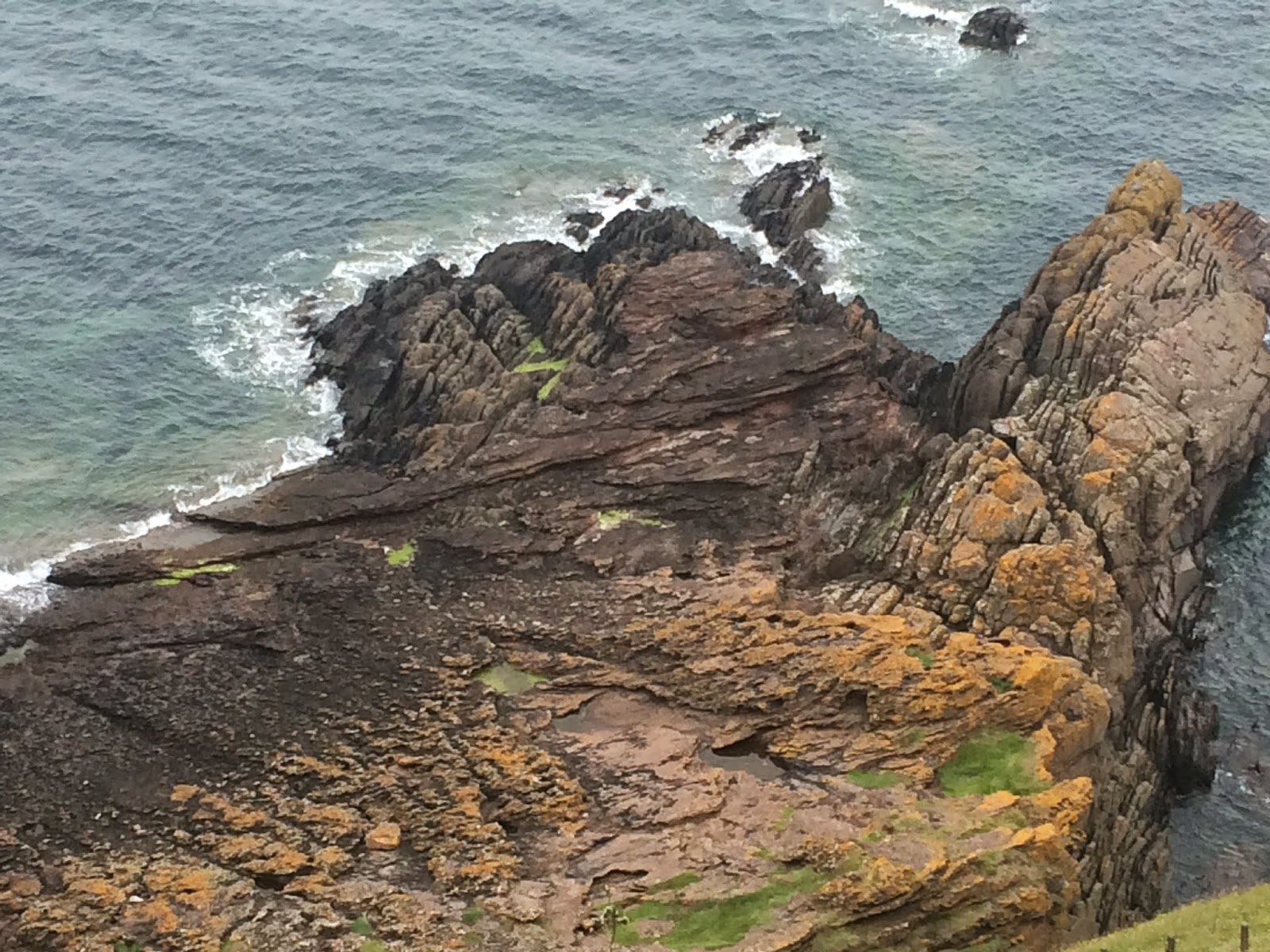
And then, finally, I climbed down the last hill and got my first view of Siccar Point. There is nothing quite like being somewhere you have seen in pictures, read about in textbooks, known that, although you might want to get there sometime during your life, it is probably out of your reach, and then suddenly you actually do get there, and realize that the pictures don’t do the place any justice and the textbook descriptions suddenly seem so clinical and meaningless. One of Hutton’s traveling companions remarked that “the mind seemed to grow giddy by looking so far back into the abyss of time” as he described the scene at the point. When I first heard this, I thought that while it probably did feel significant, to say that it caused giddiness was probably an exaggeration. I was wrong. I spun around, trying to take it all in at once. I hopped from rock to rock, knowing that this was exactly where Hutton had been and what he had seen, and even though that was 226 years in the past, it was less than a moment compared to the true age of this place. I touched the unconformity, just because I wanted to see what 55 million years felt like. And I took my one (and only) selfie for this six week trip with Siccar Point in the background. I did, in fact, become giddy.

Siccar Point from above. Photo by author.
Panorama of the area. Photo by author.
Some of the folding is visible here, as well as the more horizontal sandstone layers. Photo by author.
Hutton's Unconformity (55My). Photo by author.
Beds folded nearly vertical. Photo by author.
The view looking back towards land. photo by author.
The all-important selfie! Photo by devilishly hansom author.

Actually being there, seeing this with my own eyes and reading the signs along the way, allowed me to understand the idea of deep time in a way that I never had before. It was an idea, an abstract concept that I understood but didn’t really get. I get it now. Thinking about deep time still makes me dizzy, but now I understand it not as a sense of confusion, but one of vertigo as I stand at the top of a cliff with no base, looking down into a past so distant as to be unknowable except for the evidence that survived hundreds of millions of years so that I could stand there on the shore of the North Sea in Scotland with my mouth open, speechless.

Wednesday, July 9, 2014

STEAM AHEAD!!!

I have been traveling around on trains throughout the past few weeks and taking trains has allowed me to see much of the country.  Without transportation, I would not be able to travel around England and Scotland as easily.  It makes me wonder what people would do if effective modes of transportation did not exist.  I decided to look at the development of transportation in Scotland because many people rely on transportation to get around the country.  Last weekend, a classmate and I traveled to Nottingham and we thoroughly explored the city.  The one highlight of my trip was that I  attended the Nottingham Industrial Museum  and it is only open on the weekends.  It showcased different modes of transportation like trains and cars from the 1700's to 1800's.  Furthermore, it had a lot of industrial machines that were used back in the 1800s.

Luckily, I arrived on the last Sunday of the month so the museum was showcasing steam engines and it had volunteers who powered up these steam engines.  These steam engines demonstrate the theme of post-industrialism because they demonstrate the development of certain modes of transportation including trains. Without steam power, engines would not have run as smoothly during the Industrial Revolution.  If there were no steam engines, then there could have been a world without different modes of transportation which would have been a scary thought indeed.  I recorded many different video clips demonstrating these steam engines in use and I have edited these clips to make a quick video below demonstrating the development of steam power within the country.  I hope you enjoy the video!


Sunday, July 6, 2014

Trains of Thought

In the States, train travel is sometimes disregarded as the slowest and most boring way of getting from one place to another. A traveler might, for example, board Amtrak's Empire Builder in Chicago with nothing to look forward to for the next thirty two hours but the prospect of staring out the window at the cold and frozen expanse that is North Dakota and Eastern Montana until they finally pull into Whitefish, Montana bleary-eyed and half mad from the whole mind-numbing experience. The urge to go to sleep and lie comatose for the duration of the ride outweighs the novelty of the situation by an order of magnitude. This was my opinion of train travel for years, and as such was not looking forward to the plethora of train trips, both long and short, that this adventure would entail.

Now at the halfway point in this journey, I realize my opinion of train travel had been tainted by my one experience on American trains (the terminally dull trek described above) and I must revise my opinions on the subject. Last weekend I had the opportunity to make my way down to Nottingham, England. While this trip could have been made in a fraction of the time had I chosen to travel by air, the cost would have been far outside my travel budget, and I had yet to use any of my fifteen travel days on my Britrail train pass for a recreational excursion, so I sat down and planned out the route I would need to take to get to Nottingham at a reasonable hour. It would be a six hour trip, and if I caught the 6:32 AM train from Dundee I could get there with only one transfer. The early morning departure and lengthy transit time were unexpected, but I reminded myself that this was really the only way I would be able to go anywhere outside Dundee, and so gritted my teeth and committed to the early morning call at Dundee station.

The morning of my departure, I was struck with all manner of concerns: What if I miss the train? What if my pass doesn't work? How can I sit still for six hours? Fortunately, these worries evaporated as soon as I boarded the train and staked a claim on a window seat. As the train pulled away from the platform, I was suddenly struck by how ordinary this all seemed to the other passengers. Trains are not a novelty here; they are a way of life. To everyone else, this was ordinary. I calmed then, suddenly confident in their trust of this mode of travel, and settled in for the six hour ride. There were no snags, no confusing moments, and no delays. I arrived in Nottingham within a minute of the predicted time thinking how much more pleasant and relaxed the whole experience was compared to flying, or even driving my own car.

Why is train travel so commonplace here, while in the US it is often only a last resort? A large part of that, I think, is the distances involved. even the longest train route in the UK travels less than seven hundred miles- a long trip to be sure, but nowhere near the distances spanned by American railways. Air travel is so much more convenient over those distances that trains seem irrelevant by comparison. In addition, US railways have a poor reputation for reliability, which further lowers the opinions of many travelers. Trains were an important part of American culture, but as soon as something better came along, they were abandoned. However in the UK, and Scotland in particular, the railways are still embedded in the minds of the people as part of a national identity. Consider, for example, the city of Edinburgh's efforts to bridge the Firth of Forth. What started as a simple ferry system 900 years ago has become two (soon to be three) bridges that stand as a reminder of the times in which they were built, and the oldest of these is the Forth Bridge, an enormous cantilever rail bridge straight out of the height of the industrial revolution. This bridge has stood as a gateway to the north for nearly 125 years, and will continue to stand for the foreseeable future. It is a testament to both Scottish engineering and the importance of the railways that the first steel bridge in the world was constructed here so as to allow trains better access to the northern parts of the country, and that it still stands strong today. 

Friday, July 4, 2014

(unknown)

While the plan of not planning can take you to the more unexpected corners of a country, it can teach you a lesson in just how much to plan further on in the future with, say, other trips. Studying abroad in the UK has yet been my biggest adventure and I have yet to regret the decision of leaving a comfortable life behind to settle for a month in an unfamiliar place with so many unfamiliar faces. The residents of Dundee and all cities surrounding have been welcoming and comforting to myself and the Purdue Study Abroad group attending. Some more welcoming and excited than others, such as Ronnie at the Ninewells Hospital.

After about a long roaming tour of the Ninewells Hospital here in Dundee, I trust that I know the ins and outs of the hospital. From Frank Gehry’s “Maggie’s Centre” out back above the landscape to the hospitalization learning center for students underground, the Ninewells hospital is equipped with many features I was seeing for the first time. The atmosphere gathered an entirely new focus and theme regarding the student’s performance skills. Hands on activity is emphasized in an entirely different fashion with microphones about the ceiling and mirrored windows for supervision purposes.

Aside from the post-industrial aspects of Dundee’s newer technologies, we went back a few years or so to the Dunnottar Castle dating back to the late 16th early 17th century in Stonehaven, Scotland. Cliffs as high as 5 story buildings held the ruins of a castle so old, only sea gulls and pigeons dared to live in the dark fireplaces and cracks of its remains. Dunnottar Castle inhabited some of the most beautiful sights I had ever witnessed in life with shores similar to that of what you would find in a Pirate of the Caribbean film, large rocks where the sea meets to the shore for daring adults like ourselves to hop across for a simple look into the life under its waters. And the waters of Scotland, let me tell you about the waters of Scotland.

Our next big adventure as a group consisted of fish, bridges, and airplanes just meters overhead. On our trip to the Pitlochry Dam, streams lined the streets and cottage houses along the way. The dam was quiet and content on one side while it’s process created stirring and blundering water over the rocks on the other side. Myself and two other group members walked into town after learning about the dam, discovering a bridge not so still with pedestrians walking across, and not to mention my first fish and chips since arriving in Scotland.

 Next up was the Edradour Distillery in Pitlochry which was my first experience at a distillery. This trip gathered a many first for me as it was my first hiking experience, my first tall waterfall (which was not man-made as I was expecting the entire time), and my first beverage tasting experience.  Above the treelines we stood on our hike to to the distillery taking in the range of green fields like nothing I had ever experienced. At 800 feet we continued to the distillery where we learned of casks worth a quarter of a million pounds alongside 3,000 other casks all stacked in one warehouse for the next several years.

Having not planned any of the trips thus far, Scotland has been an incredible exploitation of many firsts for me. There is much more to look forward to being only two weeks, or a third of the way into the study abroad trip here in Scotland.

Tuesday, July 1, 2014

Environmental Technology


Living Beyond the Living Room

The living accommodations with which we have been provided by the University of Abertay are far better than I expected. We have two toilets, three shower stalls, four bathroom sinks, a large kitchen equipped with two refrigerators, one dishwasher, one fully functioning oven, one large kitchen sink, and a microwave. Furthermore, each of us is also fortunate to have our own bedrooms (which is great not only for privacy, but to avoid being kept awake with one another’s snores) equipped with a twin size bed, desk, wardrobe, overhead shelf, and a small dresser. 

University of Abertay's flat accommodations at Alloway Halls in Dundee. (Photo by author)
Needless to say, our housing situation came as a pleasant surprise for all of us, however, I couldn’t help but notice our lack of what is perhaps one of the most utilized rooms in anyone’s home - a living room. There were no couches gathered around a television, with a coffee table in the center for us to prop our feet upon after long days of studying, researching, and exploring Dundee. Though I imagine each of us could access our beloved Netflix from our personal laptops during our downtime, I found myself somewhat longing for the idea of Disney movie nights with my flatmates, curled up on couches with blankets and freshly baked pastries.

Now, don’t get me wrong. I’m not complaining, and nor did I ever resent our lack of living room. It’s just that I am most familiar with bonding with friends and family in the comfort of a living room, convinced that I was in fact living. After accepting our accommodations as they are, I became somewhat thrilled at the challenge of pursuing life outside of the living room. Our community entertainment will not come from a screen during our six weeks in Scotland, and we must learn to live beyond the living room.

Since our arrival, I have seen and done things that could never be accomplished without a break from my comfort zone. I broke away from my introverted tendencies and made friends with complete strangers. I chatted with them in pubs, live music venues, bus stops, trains, and even standing in line at the grocery store (side note: lines are referred to as 'queues' here). I've distanced myself from my somewhat lazy habits and hiked through rolling hills, skipped the bus to walk through town, and climbed numerous steep inclines and seemingly endless steps (particularly in Edinburgh!). Instead of turning to a television or computer screen for excitement, I've visited the ruins of a 16th century castle, attended a live music festival in the city, and played lots of euchre (pronounced YOU-ker... it's a 4-person card game that is very popular in Indiana) with my flatmates at the kitchen table.

The beautiful countryside of Pitlochry... My group got somewhat lost on the way to Edradour, which is Scotland's smallest distillery, located in Pitlochry. (Photo by author) 

Live music being performed at Buskers, which a church-turned-pub in Dundee. Bands played at pubs all throughout the city for the entire weekend for what was called the Almost Blue Festival. (Photo by author)

Though a living room is certainly a friendly, comfortable place to settle down at the end of a long day, there is nothing that a living room can offer that would even come close to the vitality and exuberance I have experienced since I was forced to live beyond the living room.


Friday, June 27, 2014

Paris Maker Faire 2014: A Post-Industrial Journey

Update: For more pictures from the Paris Maker Faire, see my Flickr album
For videos, check out my YouTube playlist

Last weekend (June 21 and 22), I attended a Maker Faire in Paris as part of my thesis research on maker communities. Maker Faires are physical sites where makers--anyone who creates physical things--of all types come together to showcase what they have made, and to share technical knowledge with other makers and broader publics. These events emphasize learning how to make through play and other tangible interactions with tools, technologies, techniques, and people. Of course, learning through play can be challenging when the game is played in a language you don't understand.

As I discovered upon arrival, not quite everyone at the Maker Faire spoke English. I had been nervous about the potential language barrier (see tweet below), but had the privilege of assuming that most people would speak some English.
While most of the makers who attended did make humbling efforts to accommodate my lack of spoken French literacy (for which I am extremely thankful), I was almost kicked out of the faire within 10 minutes of entering. Upon arrival, I had purchased a ticket as the Paris Maker Faire website had instructed, received my map of the faire, and was wished a good visit. Just after taking some pictures of the Make robot, a security guard started assertively directing me in French. I understood something about "no entrance... security" as he pointed toward my wrists. Meanwhile, I wondered "Wtf is going on?" I showed the guard my ticket, while pointing toward the table where I bought it only minutes before, fruitlessly trying to explain my situation in English. "No speak English" was the guard's response. He radioed something in French and shouted across the hall to another guard, trying to get the attention of someone in power who would understand my garbled nonsense. I continued holding up my ticket and pointing, as we repeated the same conversation, eventually walking down to the ticket table. Apparently, I had needed an all-important wristband to enable my physical access to the faire. Fortunately, it was as simple as showing my ticket and holding out my arm.

blue maker faire paris wristband sits vertically inside a journal of lined paperWith my new blue wristband equipped, I strode past the guard, taking a moment to feel smug, and then I recognized that all the signs at the faire were in French. Unintimidated by my lack of written French literacy, I assumed the first maker I talked to might speak eloquent and effortless English. Not so much. We didn't make it past "bonjour." Next table, same process. By that point, I was feeling that my power-granting wristband wasn't so powerful afterall, and that maybe I had made a huge mistake by planning my entire day around an event where I couldn't even communicate. "Maybe I should leave. I'll take a walk around and see what's here, take a picture of everything, and then leave; go explore Paris, see the Eiffel Tower, maybe. I could take a bus if I leave now..."
"No. You came here for research, and that's what you're going to do. Enjoyable or not, you're here, John. And you're not giving up yet."
"Maybe I can just walk around and not talk to anybody for a while. That will be easier. That will feel safer. Maybe I got more out of the Cincinnati Mini Maker Faire than I will from this one."
"If it's challenging your spirits, and what you know, do it, even when it's hard. You came because you wanted this. It's a game, and you're new here. You're supposed to be bad at this for the first level. That's how research happens. Why are you feeling uncomfortable? What about this situation is making me feel this way?"

I decided to walk the faire for a while and see what caught my eye. I snapped a few photos, and then found a giant 3D printer printing chairs. The printer by Drawn was something I could understand easily, and sitting in a 3D printed chair was pretty cool. That alone gave me the confidence to roam around and explore a bit further.


three Make robot pins in a horizontal line
While there were many exciting sights, sounds, smells, tastes, and textures at the Maker Faire, I quickly understood that within international maker communities, it's relatively easy to learn the mechanics behind a machine or the process behind making an object. For example, I successfully soldered a Make robot pin with LED eyes, despite having instructions written in French, a few notes in English, the ability to watch people around me, and no experience of soldering things together rather than de-soldering. Granted, it took me three tries to get it right, but I managed, and could explain the process to someone else. However, the nuances of the instructions were lost. The how and why explanations too. The same could be said for building almost anything.

In a post-industrial economy, in which a critical mass of makers have access to fundamental components and tools, nuances of how and why explanations behind designs become very important. For example, the primary distinction between trains in the U.K. and trains in the U.S.A. is not the technology of the train itself. Rail companies in countries around the world can purchase the same electric locomotive, the same rails, the same equipment and essential components. What separates them are the configurations of those components, as well as the fit of those configurations to different contexts. The trains here in Scotland run very quietly, and there is little difference in volume between riding in an open field or riding through a tunnel. In Chicago, on the other hand, the distinctively deafening roar of a train rushing through a tunnel is part of what defines that particular line. If one were to attempt the same configuration in Chicago, users might resist and find it ill-fitting. Thus, there is a significant rhetorical component to post-industrial configurations of technology.

And although there were many interesting things I learned from my journey to Paris, and some unforgettable experiences, the most surprising outcome was how visiting Paris and the Maker Faire changed my perspective on Dundee. What only a week ago seemed unfamiliar, with foreign accents and winding roads, now feels comforting; homely even, compared with Paris. Here, at least I can ask for a burger without wondering whether anyone will understand my request. The configurations of the systems may be different here than in the U.S., but I can communicate about both the components and the rationale behind the configurations.

It's About Dam Time

   When you tour a dam, the discussion will invariably turn to that dam's "worlds first," "world's only," or "world's best." It seems to be a unique ability of dam builders to always come up with a first, only, or best that makes their project unique. 

   The self-guided walking tour at the Pitlochry Dam and Fish Ladder, then, came as a pleasant surprise. In contrast to the other dams I've visited, the focus wasn't about construction or how much power the dam produced, but instead focused almost exclusively on the environmental impact of damming, and the need for green energy sources in the future. 

This first sign aptly set the theme of the tour for visitors walking to the dam from the north side of the river.

The  first sign most visitors encounter on the dam. Photo by author
This turbine is fish-friendly. It acts like a revolving door to allow fish moving downstream to pass through the dam unimpeded.

The turbine spins on a vertical axis instead of a horizontal one. Photo by author
A dam, by definition, blocks the flow of a river. This fish ladder allows more than 5000 salmon and other species each year to pass unimpeded to their spawning grounds upstream.

The ladder is composed of a series of tiered pools that allow the salmon to move around the dam. Photo by author
 The pools of the fish ladder are designed to allow fish to easily move from one to the next.

The murky environment of a pool. Photo by author
A downstream view of the dam from downstream shows the main structure partially hidden by the surrounding forest. 


   The Pitlochry Dam doesn't focus on its first, only, or best. Instead, throughout the tour it discusses the importance of green energy and how to lessen the environmental impact of large industrial and post-industrial projects. With Scotland's deadline of 100% sustainability by 2025 rapidly approaching, it is important that projects like the Pitlochry Dam and Fish Ladder continue to pay careful attention to the affects they have, not just on the energy grid, but also on the environment in which they are built.