Friday, July 11, 2014

Chicago to Edinburgh

With the hustle and bustle of busy shoppers and business owners about Dundee, it was nice to know that a weekend of local music and drinks was soon to happen. Scotland’s Almost Blue festival presented the nightlife and entertainment much needed for a few college students to bond socially with those of Dundee. I was ready for a few days of being able to meet the people of the city in which I have lived for close to a month now. I was given the opportunity to meet a countless number of folks from all over the city and even other regions as well as hearing their stories while having lived in an entirely different country than my own. I and a few others from the group befriended a member of a band who spoke nothing but great things about The States and how his major goal included moving to California. We continued to other pubs around the city through the late hours of Saturday before a new week about Scotland.

After winding down the nightlife and entertainment, it was time to travel to a city so beautiful it may have made its way to some of my favorite cities.  Like Chicago, Edinburgh is fast paced and addicting in its sense of beautiful color, infrastructure and people. Prince Street presents itself as most similar to the Magnificent Mile in Chicago’s downtown area. Having left the research to the side, I was amazed at the scenery I could capture in practicing my theme of the unplanned adventures I did plan to encounter. I felt a sense of home in the culture of Edinburgh when so many things were comparable to a city I had visited so much back home so it was important for me to take in as much as I could while there the first time. I walked the city streets of Edinburgh every moment that I could as well as taking in the nightlife along with a countless number of travelers like myself.

The array of entertainment in Edinburgh was an experience unlike I have had yet. The people of Scotland are as friendly as you could imagine with generosity and passion for fun like nothing I have witnessed either.

In the midst of socially absorbing the city of Edinburgh, the group met for the presentation and walk along the Forth Road Bridge with a breathtaking view of the other Forth Bridge across the water. I found fascinating the history of the workers and their views on safety connected to the reputation of manhood during the time of building these bridges. Having refused the helmets and other safety gear presented to them by the authority of those running the plans, many men died giving labor and even their living capacity away to build this bridge. We saw photos of men hanging their clothes alongside the ends of the bridges in order to complete the project that would take 7 years.

Wednesday, July 9, 2014

STEAM AHEAD!!!

I have been traveling around on trains throughout the past few weeks and taking trains has allowed me to see much of the country.  Without transportation, I would not be able to travel around England and Scotland as easily.  It makes me wonder what people would do if effective modes of transportation did not exist.  I decided to look at the development of transportation in Scotland because many people rely on transportation to get around the country.  Last weekend, a classmate and I traveled to Nottingham and we thoroughly explored the city.  The one highlight of my trip was that I  attended the Nottingham Industrial Museum  and it is only open on the weekends.  It showcased different modes of transportation like trains and cars from the 1700's to 1800's.  Furthermore, it had a lot of industrial machines that were used back in the 1800s.

Luckily, I arrived on the last Sunday of the month so the museum was showcasing steam engines and it had volunteers who powered up these steam engines.  These steam engines demonstrate the theme of post-industrialism because they demonstrate the development of certain modes of transportation including trains. Without steam power, engines would not have run as smoothly during the Industrial Revolution.  If there were no steam engines, then there could have been a world without different modes of transportation which would have been a scary thought indeed.  I recorded many different video clips demonstrating these steam engines in use and I have edited these clips to make a quick video below demonstrating the development of steam power within the country.  I hope you enjoy the video!


Tuesday, July 8, 2014

Amble on a Thousand Years of History

After six hours of train ride, my friend and I were in London for the weekend. This time we visited the famous historical site, Tower of London. People came from different places stood in the queues under the torrid sun just for purchasing the tickets. Finally, we bought our tickets and entered the castle with excitement.
Tower of London - taken by Ho-An Chien

We saw the yeoman warder who also known as “beefeater” while entering the main gate. The name “beefeater” came from the reason that they were the guards who were granted by the king the right of eating as much beef as they want from the king’s table. Yeoman Warders acted as tour guides and securities at Tower of London and they were part of the attractions as well. They were not just common old men because each of them must serve in the military for at least twenty-two years before retire and own the medal of Long Service and Good Conduct.
Yeoman Warder (Beefeater) - taken from http://www.kpbs.org/photos/galleries/secrets-tower-london/

        Tower of London is a castle composed by various distinguishable towers and each of them is built in different period that served distinctive purpose. The earliest tower, White Tower, is built at the end of the eleventh century. The name has come from the fact that the tower has painted in white. Before, it served as residence to the royal. However, it holds the exhibition of weaponry and armour from different time for now. Besides the arsenal inside the White Tower, there is another royal fusilier museum located in the castle where it displays the war diaries, photographs and private letters from the wars. All the displays makes one feel like he has accidentally falls back into time. 
White Tower - taken from http://www.mummytombs.com/museums/uk.london.visit.htm

Weapons displayed in White Tower - taken by Ho-An Chien

Another popular tower with special crown jewels exhibition is named Waterloo Barrack. There has been an extremely long line for people who want to see the crowns, truncheons, swords and dining utensils made from gold. Everything in the Jewel House is gorgeous and extravagant, however, photos and videos are not allowed. Thus, I am unable to share the beautiful masterpieces even though I yearning to do so. 
Apart from the glorious history of Great Britain, I also learn the dark side from the notorious Bloody Tower. It is called Bloody tower due to several reasons. There have been two little princes missing and murdered. Then, a noble, Sir Thomas Overbury, has been poisoned. Moreover, this tower is sometimes used as a prison for important prisoners.
Jewel House - taken by Ho-An Chien

Bloody Tower - taken from http://curiosidadesaristocracia.blogspot.co.uk

Aside from the aforementioned towers, there are many more and each of them has its own stories. One of the most interesting and also haunting stories is the tale about Henry VIII's second wife, Anne Boleyn. She is accused of treason, adultery and incest. Thus, she is beheaded at the Green Tower on May 19th. Later on, many guards of different period have seen the headless queen in numerous places in the castle. The tale is so popular and wide-spread among the tourists.
River Thames and Tower Bridge - taken by Ho-An Chien


As I walked on the passage of the castle wall and looked at the direction of River Thames and Tower Bridge, the proverb “He that travels far knows much”suddenly appeared in my head. From this visit, I finally savvy the adage. I felt this tour taught me more history knowledge than a textbook would. Thus, in my perspective, Tower of London is like a living history book than just a common tourist attraction. One can actually learn more history within a few hours by walking in the castle than just sitting on a chair to study a history textbook. I think the proverb really does have its reason.


Monday, July 7, 2014

So much Scotland, so little time

In the past week I have spent much of my time traveling, I traveled over 500 miles, spent nights in 4 different cities, and hiked to the tallest point in the UK. Most of my travel was done by train supplemented by a couple bus rides. Below is a roughly mapped outline of my travels.
a map of scotland overlayed with a traced path of 500 miles
Map of my travel from 6/28/14-7/3/14 (from Google maps)
I started my adventure in Dundee early on Saturday morning, I rode the train from Dundee to Inverness switching at Perth. I headed straight to the bus station and caught a bus to Urquhart, a ruined castle on the shores of Loch Ness. The castle was fantastic, and has a very rich history, but the site was a bit too touristy for my taste. Unless historical importance and a stocked gift shop are what you are looking for, I would recommend the ruined Dunnottar castle, near Aberdeen, a less crowded alternative.
Urquhart Castle and Loch Ness, taken from "Taylor Dundee"
After a 30 minute bus ride back to Inverness the clouds broke, revealing some much appreciated sun. While strolling around Inverness I found an hole in the wall book shop that was incredible, shelves everywhere, books from floor to ceiling on any subject imaginable, and of course that overwhelming smell of old pages. Then I walked along the banks of the river ness soaking up the evening sunlight before grabbing a bite to eat and heading to the Inverness Student Hostel. This place was awesome, it wasn't big or fancy but it had energy, the common room was filled with people from all over the world happy to mingle and share their experiences.

In the morning I made a quick breakfast and headed to the bus station for a ride to Fort William. Even the bus ride was beautiful, but it was just a precursor to the glorious day Scotland had in store for me. I got of the bus in Fort William and walked about a half hour to the start of the path up Ben Nevis. As I started the hike up I could tell it was going to be an amazing day, the sun was beaming through the clouds, and there was plenty of blue sky. The hike began weaving through fields of grazing sheep before cutting up the first steep hill.  
a photo of a couple sheep grazing in a green field near the base of Ben Nevis
Sheep Grazing just off the mountain path (photo credit author)
After about an hour of steep rocky trails I came to a valley between Ben Nevis and an adjacent hill, here there was a picturesque lake and a much needed reprieve from the strenuous incline.
Beautiful Loch Meall an t-Suidhe, AKA the halfway lochen (photo credit author)
This is where the Carn Mor Dearg Arete path split from the mountain path, I took the less traveled Carn Mor Dearg route around the north face of the mountain. Though it is the more difficult ascent this path gives much better views.
North Face of Ben Nevis (photo credit author)

 Although the path was nearly empty I did pass a couple on Carn Mor Dearg who took a photo of me with the impressive north face of Ben Nevis in the background.
Me and "The Ben" (photo credit anonymous hiker)
Panoramic view from the Carn Mor Dearg arete with "The Ben" on the right (photo credit author)  
 After traversing the exposed ridge and making the final push up the steep talus field I made it to the summit. Standing at the top, the highest point in the UK, gives you the feeling you are on top of the world. The surrounding mountains, glens, and lochs make for stunning panoramic views.
Looking south from the summit (photo credit author)

I took a lunch break on the summit enjoying the spectacular views until I could motivate myself to start the knee-jarring, back breaking, 1344 meter descent down the mountain path. In all the hike was a 12 mile loop that gave me some of the most spectacular views of my life.

I stayed the night in the Glen Nevis Youth Hostel, a higher end hostel near the Glen Nevis visitor center. In the morning I did a short hike that took me back to Fort William, where I caught a train back to Dundee. Even though I was tired there was no way I was going to fall asleep on that train ride. I continued to be mesmerized by the countryside throughout the entire 6+ hour train ride. We traveled through some bleak moorlands that had a haunting beauty, my chest still tightens when i think about them. When i finally arrived in Dundee I was pooped, but I had no reprieve as I was leaving for Edinburgh the next day.

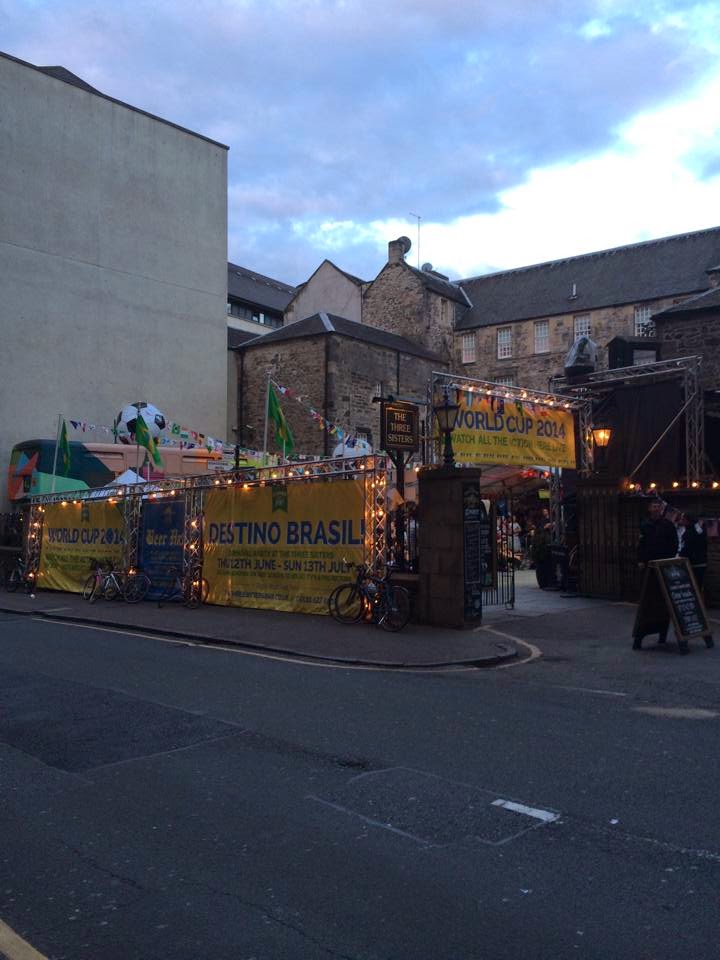
Edinburgh is a bustling tourist mecca, but that made the stay there no less enjoyable, the first evening we walked up and down the royal mile, and stopped to eat at a fantastic burger joint called Burgers and Beer. Then we went to an awesome outdoor bar area to watch the USA vs. Belgium World Cup match, there was a huge outdoor screen that they were showing the game on, the place was packed with other USA fans, the atmosphere was perfect, and the match was thrilling, unfortunately USA didn't come out on top. After the game we called it a night and crashed at our hostel.
The crowd watching the football match (photo credit author)

On Wednesday we had a class tour at the Forth Replacement Crossing Education Center, the presentation was very interesting and I learned a lot about the progression of Forth crossings. From small stone bridges 30 miles upstream from Edinburgh to the massive steel rail bridge and the cable stay bridge currently under construction. We then got to walk out on the existing road bridge to get a better view of  impressive bridges.
The beginnings of a new bridge (photo credit author) 

The red Forth bridge in the backround (photo credit author)

After the tour much of the class joined me at Arcade Haggis and Whiskey, a small restaurant with highly reviewed haggis. I ordered the classic haggis served with neeps and tatties (mashed turnips and potatoes), It was served in a beautiful tower with potatoes on bottom followed by beats then haggis. The dish was delicious, the haggis was flavorful and moist, and the turnips and potatoes complimented it nicely. After our adventurous dinner we explored downtown Edinburgh for a couple more hours before heading back to the hostel.
Delicious haggis (photo credit author)

Our final day in Edinburgh started by exploring the past in the National archives. We got to hold and read some documents relating to the forth bridge and the Forth to Clyde canal. It was crazy being able to touch such old documents, newspaper clippings from the early 1800’s, proposals from the 1700’s, and original invitations to the forth bridge opening. After our research in the national archives was complete I did the short but steep hike up to Arthur’s Seat, an extinct volcano looming over Edinburgh, got some great views of the city from the windy peak. Finally I caught a train back to Dundee, ending my busy week.

Sunday, July 6, 2014

Trains of Thought

In the States, train travel is sometimes disregarded as the slowest and most boring way of getting from one place to another. A traveler might, for example, board Amtrak's Empire Builder in Chicago with nothing to look forward to for the next thirty two hours but the prospect of staring out the window at the cold and frozen expanse that is North Dakota and Eastern Montana until they finally pull into Whitefish, Montana bleary-eyed and half mad from the whole mind-numbing experience. The urge to go to sleep and lie comatose for the duration of the ride outweighs the novelty of the situation by an order of magnitude. This was my opinion of train travel for years, and as such was not looking forward to the plethora of train trips, both long and short, that this adventure would entail.

Now at the halfway point in this journey, I realize my opinion of train travel had been tainted by my one experience on American trains (the terminally dull trek described above) and I must revise my opinions on the subject. Last weekend I had the opportunity to make my way down to Nottingham, England. While this trip could have been made in a fraction of the time had I chosen to travel by air, the cost would have been far outside my travel budget, and I had yet to use any of my fifteen travel days on my Britrail train pass for a recreational excursion, so I sat down and planned out the route I would need to take to get to Nottingham at a reasonable hour. It would be a six hour trip, and if I caught the 6:32 AM train from Dundee I could get there with only one transfer. The early morning departure and lengthy transit time were unexpected, but I reminded myself that this was really the only way I would be able to go anywhere outside Dundee, and so gritted my teeth and committed to the early morning call at Dundee station.

The morning of my departure, I was struck with all manner of concerns: What if I miss the train? What if my pass doesn't work? How can I sit still for six hours? Fortunately, these worries evaporated as soon as I boarded the train and staked a claim on a window seat. As the train pulled away from the platform, I was suddenly struck by how ordinary this all seemed to the other passengers. Trains are not a novelty here; they are a way of life. To everyone else, this was ordinary. I calmed then, suddenly confident in their trust of this mode of travel, and settled in for the six hour ride. There were no snags, no confusing moments, and no delays. I arrived in Nottingham within a minute of the predicted time thinking how much more pleasant and relaxed the whole experience was compared to flying, or even driving my own car.

Why is train travel so commonplace here, while in the US it is often only a last resort? A large part of that, I think, is the distances involved. even the longest train route in the UK travels less than seven hundred miles- a long trip to be sure, but nowhere near the distances spanned by American railways. Air travel is so much more convenient over those distances that trains seem irrelevant by comparison. In addition, US railways have a poor reputation for reliability, which further lowers the opinions of many travelers. Trains were an important part of American culture, but as soon as something better came along, they were abandoned. However in the UK, and Scotland in particular, the railways are still embedded in the minds of the people as part of a national identity. Consider, for example, the city of Edinburgh's efforts to bridge the Firth of Forth. What started as a simple ferry system 900 years ago has become two (soon to be three) bridges that stand as a reminder of the times in which they were built, and the oldest of these is the Forth Bridge, an enormous cantilever rail bridge straight out of the height of the industrial revolution. This bridge has stood as a gateway to the north for nearly 125 years, and will continue to stand for the foreseeable future. It is a testament to both Scottish engineering and the importance of the railways that the first steel bridge in the world was constructed here so as to allow trains better access to the northern parts of the country, and that it still stands strong today. 

Saturday, July 5, 2014

Trips Outside Dundee

Other than visiting RRS Discovery and the jute museum in Dundee, we also visited a local museum briefly introduces the history of Dundee. Then we began our tours outside Dundee, to explore some different aspects of this post-industrial world.

The first place we visited was Glamis Castle. I strongly encouraged people to go there because it was a really nice place and the guide did the perfect job. However, Sunday is definitely a better day to visit there because you will then have a bus go straightly to the castle. If you don’t mind transferring, I still recommend you to check the length of layover.

Actually, this was the biggest mistake we ever made over this trip. We hopped off the bus at a place called Newtyle and we were supposed to get to bus number 125. However, we found that we had to wait for about three hours, under the condition that we had no idea where this place was, or where to go. We couldn't even find a cafe around the bus stop. So we decided to walk to the castle, to save the time from waiting and doing nothing at Newtyle. Yes, we walked. It was about a 7 miles long walk and it took us for about three hours. We were so exhausted and almost about to give up. The road to glamis seemed endless.

An endless road to Glamis
Photo credited to Yi-Wei Lee

Glamis Castle
Photo credited to Yi-Wei Lee

The most frustrating thing was we actually arrived at the front door of the castle at the same time as the bus did. Not sure whether we were supposed to be happy or not. Anyway, at least we made it. The tour was so nice that I didn’t feel tired anymore. The guide told a few haunted stories and left you a lot of time to walk around and take a look at the rooms in the castle yourself. We also learned some interesting fact. For example, people didn’t lie in the bed for sleeping. They actually sat on the bed instead, because they believed only dead people would lie down.

We also gained some train traveling experiences. Pitlochry, a beautiful place with so many flowers and tourists. The restaurants there were a little more expensive than those in Dundee. But the city center was great, with a lot of small shops. The reason we visited there was the dam and fish ladder. Since we were studying the clean energy and discussing some new technology, we actually visited this place and got to learn how it works to produce electricity. The dam was a little bit strange to me. It had these two sides of completely different scenery and a bridge just like a dividing line of these two. One was so peaceful and I was amazed because it looked like a scene that you will see in movies. The other, however, was not as beautiful as the other side was, but we could actually visually study how whole energy thing works out.

Just like a movie scene
Photo credited to Yi-Wei Lee


We spent the weekend in London. We headed straight to London the day after the Pitlochry trip. Also traveling by train. And one of the most interesting thing I had seen over the weekend was this small protest at Harrod's. Around 3 or 4 P.M., we happened to see a bunch of people all gathering outside the department store. They were all yelling something likes “shame, shame, shame on you.” We were curious, so I took a flyer from a young lady. It looked like they were claiming that a luxury brand’s designer stole a symbol or something as his own trade mark. I never had a chance to see a protest before, so this was kind of a freshly new thing to me. We stayed for a while watching them, although I still don’t know what they claimed were true or not.


Friday, July 4, 2014

Tourism and Identity

Edinburgh
I had eaten haggis the night before, a minute's walk from the train station, and took a photo to prove it, to remember what it had looked like. The next day, walking through the bustling streets of Edinburgh, I desired to escape the American teenagers on vacation and masses of heteronormative white families with 2.5 children in tow. I wanted to hear the different sounds of native Scots, the daily grind of familiar faces at bus stops, and the whining children that exist anywhere in the world. In Edinburgh, the single mothers shopping, tired fathers taking kids off to school, and the people just enjoying a lunch break outside had all been seemingly swept away by a simulacrum of loud Americans looking for the nearest tour bus stop. And there I was, living in that simulated environment, after visiting the Scottish National Archives to learn more about the construction and communication of the Firth of Forth bridges; after discussing the transition from preserving original documents to creating digital copies. There was a strange contrast between the day before, spent learning about the construction of the Forth Replacement Crossing by looking at models as well as the cable-stayed bridge under construction, and the recognition that Edinburgh was a different type of construction as a tourist destination. Perhaps it was the lack of scaffolding at the tourist sites that made it different, something Amelia discusses in one of her posts this week.

Perhaps this strange desire for separation was also a shift in my desire to document, which may have been influenced by my lack of camera as much as my attitude toward the place. The tangible proof of my journey lies not in pictures, but in the whisky and rum from Cadenhead--the drinks themselves unique only because their origins are untraceable beyond geographic regions. But my motivations for buying the spirits weren't to prove that I existed on Scottish soil; I bought them because I wanted to try them, affordably. But such motivations are often invisible, indistinguishable from the gawking tourist who simply wants to take it all in and try new views and experiences to say, "I went to Edinburgh! I was there!" Yet I didn't want to have the same Edinburgh pictures as the 500 other people staring at the same thing, despite my recognition of the absurdity of trying to distinguish myself from the generations of locals, travelers, visitors, and tourists that have come before me and who looked at the same things. Perhaps it was as simple as wanting to walk into a store without being instantly labeled as a tourist; not wanting to defend my identity as an American non-tourist-student-researcher-3-week-resident; not wanting to deal with the assumption that I had only arrived that morning (because why else would I visit Edinburgh, I guess?), or that I was only there to tour the castle and overlook the rest as too real. I didn't want to be labeled as just an-Other tourist, someone to be easily dismissed as temporarily existing, with limited value, and not to be taken seriously. I just wanted to exist and enjoy the experience without being judged, says the American white guy in Scotland doing research towards his PhD and buying alcohol for the experience.