Last week I wrote about the ways places/artifacts/work in progress are hidden and covered and/or announced or displayed, to various degrees. Those ideas and some of the other readings I’ve been doing have led me to a really great and useful-seeming metaphor: the black box.
I have classmate Ben (plus the ever-handy Wikipedia) to thank for enlightening me as to the surprisingly simple origins of this term. It comes from electronics, where a black box is literally an opaque box of wires that do magical, unseen (but not un-detectible) things.
The
general definition gets a bit fancier: “a device, system or object which can be viewed in terms of its input, output and transfer characteristics without any knowledge of its internal workings.”
Black boxes are everywhere. Almost anything can be interpreted in some black-box-ish way for someone. Part of what modern life is all about involves some things being mysterious to some people but not to others; specialization allows us to safely ignore a lot of stuff in favor of becoming an expert in a more manageable amount of stuff. The deceptive simplicity of the black box concept makes it easy to apply and fairly easy to talk about. How useful will it be for me and my as-of-yet wild, untamable research interests? I'm not sure.
A seemingly-tangential thought on black boxes and all the frames in which they show up comes from Andrew Feenberg's collection of essays
Between Reason and Experience. He uses the example of steamboat boilers in the early 1800s. At first, there was no regulation, no legally enforceable standards for boilermakers. Society seemed fine with the risks of exploding steamboats for years... until, finally, when laws were eventually passed to enforce safety measures, the standards those laws enforced became part of what made the technology of the steamboat boiler what it from then on was. No other kind of boiler could be considered a "proper boiler" (22). No other way of making this thing was acceptable, so the standard solidified into a default technical code. The code itself was never questioned, rarely examined at all. The process whereby it was decided upon faded away and allowed the code to function as a closed book, efficient and nigh-invisible. According to Feenberg, standardization is a black-boxing process. Once a standard forms, it tends to become an unquestioned, unexamined packet of the Way Things Are.
From here, it gets a little bit easier to see whole networks of infrastructure, whole paradigms and vast ideologies as black boxes. They are at work in the way things happen in our lives, but we don't often notice them, much less look inside them. Almost nobody questions whatever gets put in the boxes, especially if some official, complicated, voted-on ruling put it there. it’s settled. That system becomes dominant and invisible.
That doesn't mean we absolutely can't see them though. Electricians un-black-box light switch wiring and fuses all the time. That's their job. Academics un-black-box (or attempt to) ideologies all the time, too. That's their job.
Interestingly, the black box has an opposite: the clear or glass or white box. These are systems or objects that open themselves up to every scrutiny, eager to show off their inner workings. The clamor for transparency is a hunger for more (and hopefully friendly) white boxes and fewer (monolithic and scary?) black boxes.
But I wonder if no matter how transparent or open we try to make the boxes we work with (and/or within), maybe we’ll always find more black boxes inside. I'm indebted to classmate John for the wonderfully allusive phrase "Black boxes all the way down" to describe this. He responded (via good old facebook) to my post
over here with the thought that "transparency largely depends on perspective. For example, opening the (sometimes literal) black box of a printer, with the goal/perspective of fixing a paper jam, repairing a component, salvaging electronics, getting at scrap metal, etc., means different versions of transparency." I love the word
matryoshka for describing these arrangements,
even if I do occasionally misspell it. The matryoshka-ness of black boxes specifically is very possibly one of the most mind-bendingly fascinating things I've thought about for a long time.
Now I want to ask questions about when and why certain ideas or technologies get black-boxed and when they get un-black-boxed. What kinds of influences make us stop at which black box (or painted doll)? As John mentioned, there are varying layers and motives for cracking open a black box. Maybe it's your job, maybe its a toy, or maybe both. Everyone has a different level at which they might need or want to understand or be proficient with any given technology. But on a general paradigm-sized scale--say on the scale of general knowledge and expectations about the world--what should we consider black-boxed and when?
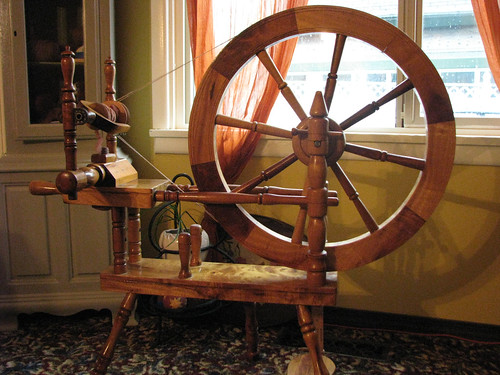
{ photo by this kind soul on Flickr. }
Does this spinning wheel count as a black box? Do you know how to use the thing? You see them in movies and maybe at a historical re-enactment or two. Does that mean the technology is accessible?
I'm not sure. I don't know if I could use a spinning wheel, though I've seen it done. How much do I need to know to be inside the black box? Even if you spend hours watching somebody sitting at this wheel with a basket of flax or wool, feeding fibers through and around and into the machine, does that mean you really
get it? This is where the levels come in, I guess. You might sort of get it--at least moreso than anyone who had only ever seen flax and thread (or fabric--but that's another machine/box altogether) on totally separate sides of the process.
Last week on Wednesday I visited
Dundee Contemporary Arts for their weekly knitting workshop. Two others were there and we sat for an hour and a bit chatting about Scotland, the referendum, the world cup (are you supposed to capitalize the world cup? are there rules about that?), cars, and housing developments. I don't knit, really. But I have learned (and forgotten) how to do it more than once. I wouldn't call knitting expertise a total black box for me. Even though crochet is more my thing, crafts of this kind are part of the world I regularly inhabit and interact in. I can see and recognize how knitting happens--not just that a ball of yarn can become, somehow, a sweater, but that needles of a certain size, the number and position of those needles, plus a very particular pattern of stitches all matter in that process. This knowledge goes some way to un-black-boxing all kinds of knitwear and other knitted/crafted material for me. I can read those parts of the manufactured world at a basic level.
Out of curiosity, I did some research on knitting, past, present, and future. In the beginning, we humans wanted to keep our feet warm, so we invented an intricate way of looping and knotting string into fabric shapes. But sock-making is not why I keep yarn and a crochet hook around today. Like hand-spun thread, hand-made socks are a rarity. You probably don't have a spinning wheel sitting in your living room and you probably buy your socks from a store. We don't need to make our own socks or anyone else's. We have giant industrial knitting machines for that.
Even after watching a very cheesy video about how this process works, computerized knitting seems much more of a black-box than hand-knitting does to me. All those machines probably contain their very own individual galaxy of black boxes, too, not to mention the protocols and standards set up for spool widths and sock sizes and all the electricity it takes to run such a factory.
Is this what industrialization means? An exponential increase in the black-boxiness of even the making of a sock? Assigning most of the work to machines and divvying up the rest among specialists and technicians?
If so, perhaps post-industrialization means unearthing the black boxes of the past and returning to pre-industrial methods out of non-industrial, non-commercial, non-essential motives.
Today, in this arguably post-industrial century, most people don't knit because they need to. Knitting is a lovely, relaxing hobby. If you get a pair of socks out of it, cool. But that isn't the primary end. The end and the means overlap here: you enjoy knitting for its own retro/crafty/creative sake.
The morning after my visit to Dundee's knitting circle, we went to see the Falkirk wheel. This is a peculiar project, one of many funded by the
Millennium commission over the past dozen or two years. There is a lot to be learned at the site. Seeing the wheel itself and getting a sense of its place between the Forth and Clyde and Union canals is much cooler than reading about these things on the
Scottish Canals website, though there is plenty to be learned there, too. The connection between these canals and knitting came to me over the course of our long Thursday excursion up and back down the wheel and then along the canal itself.
The Falkirk wheel exists to be looked at, not really to accomplish anything. Much like the warmth of my feet does not depend directly on my crochet projects, the economy of Scotland doesn't directly depend on this magnificently engineered section of a long series of canals. There are industries and markets surrounding these two technologies, sure: tourism, novelties;
Etsy and craft supply stores. These are markers of post-industrial society as well, perhaps. More and more specialization, more and more extended niches where money can be made and life can be spent.
Both the Falkirk wheel and the DCA knitting group have their deepest roots in the technologies and crafts of pre-industrial life. Canalboats and hand-knitting aren't technically extinct technologies (yet); so far their boxes can be easily unearthed, un-blacked, and we can access/support these avenues, processes, and skills if we want. But we'll probably do so for the sake of the things themselves. For leisure and not as a means to some other, more essential end.


